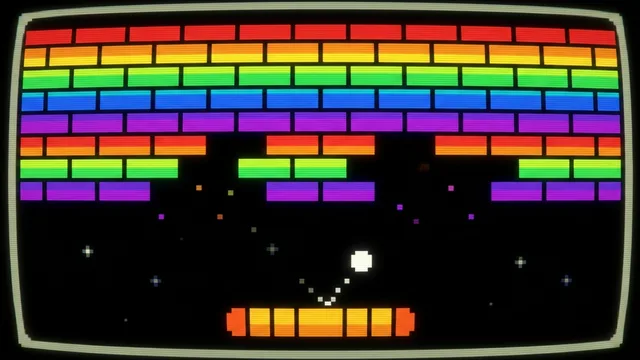
Inside the Breakout Cabinet
TL;DR: Bounce the ball off your paddle to smash every brick in the wall. Expect gentle start, spicy final rows at a pace that's speeds up as bricks fall.
Breakout hands you a paddle, one ball, and a wall of bricks that has been asking for it since 1976. Bounce the ball up, smash a brick, catch the rebound, repeat - Simple to say, hypnotic to do.
The real game lives in your paddle: where the ball lands on it decides the angle it flies off at, so you are not just defending, you are aiming every single shot. Dig deep and the wall fights back - The ball picks up speed when it bites into the higher rows, which also happen to pay the most points.
Our version keeps the crisp arcade feel with mouse, keyboard, and touch-drag controls, stacks fresh walls as you clear them, and adds a daily seeded run where every player faces the identical bricks. Climb the leaderboard, or just enjoy the oldest satisfying sound in gaming: brick, gone.
Cabinet Specs
| Mission | Bounce the ball off your paddle to smash every brick in the wall. |
|---|---|
| Row | Arcade Classics |
| Skill curve | Gentle start, spicy final rows |
| Tempo | Speeds up as bricks fall |
| Lineage | 1976 (Atari) |
| Original | Breakout - Atari, 1976 (full history) |
| Daily run | Seeded challenge, resets midnight UTC |
| Scoreboard | Global top 50, score-ranked |
Learn Breakout in Five Moves
Launch the ball
Press Space, click, or tap to serve. The ball leaves the paddle and heads for the wall of bricks at the top of the screen - From here on, keeping it in play is your whole job.
Slide the paddle under the rebound
Move with the mouse, the left and right arrow keys, or a finger drag on mobile. The paddle only moves side to side, so read the ball's angle early and get there before it does.
Aim with the paddle, not luck
Where the ball lands on your paddle sets the return angle. The outer edges fire it back steep and wide; the center sends it up nearly straight. Every catch is also a shot.
Break into the high rows
Bricks near the top are worth the most points, and the ball gains speed when it smashes into those deeper rows. Big scores and big trouble arrive together - Be ready for the faster rebound.
Clear the wall, protect your balls
Let the ball drop past your paddle and you lose it; lose your last one and the run ends. Wipe out every brick and a fresh wall appears with your score intact.
Score Higher at Breakout
Carve a channel up one side first. Once the ball squeezes above the wall, it pinballs across the top rows on its own - Clearing the highest-value bricks while you just wait underneath for it to come back.
- Use the paddle's outer thirds on purpose. Steep angles cover more bricks per trip up the screen, so deliberate edge hits clear a wall far faster than a string of safe, straight bounces.
- Center the ball when you are rattled. A flat middle-of-the-paddle return is the slowest, most predictable rebound in the game - Use it to reset your nerves before the next aggressive shot.
- Watch the ball, never the bricks. The explosion up top is a distraction; the only thing that ends your run is the ball crossing the bottom, so keep your eyes glued to its descent.
- Pre-position for the speed jump. The first hit on a deep row makes the ball come back hotter than you expect - Start moving toward its landing spot the moment it strikes high.
- Bank shots off the side walls. A ball riding the wall sweeps sideways across a row, chewing through bricks a straight vertical shot would need five trips to reach.
- Slow the endgame down. With three bricks left, players get greedy and whiff easy catches - Take flat, patient returns and let the angles finish the wall for you.
House Rules & Spin-Offs
Super Breakout
Atari's 1978 sequel added Double, Cavity, and Progressive modes - multiple balls in play at once and walls that creep steadily downward.
Arkanoid
Taito's 1986 evolution dropped power-up capsules from broken bricks: lasers, a wider paddle, multi-ball, and even a final boss.
DX-Ball
The 1996 PC freeware favorite that lived on a million office computers, famous for huge levels and a rain of power-ups both helpful and cruel.
Breakout: Recharged
Atari's 2022 neon remake with modern physics, missions, and co-op - proof the wall still has fans half a century later.
Breakout Questions, Answered
What is the goal of Breakout?
How do I control where the ball goes?
Why does the ball keep getting faster?
What is tunneling and should I do it?
Did Steve Jobs and Steve Wozniak really build Breakout?
What happens when I miss the ball?
Is the daily Breakout run the same for everyone?
Can I play Breakout on my phone?
More where Breakout came from: work through the arcade classics row, brush up in the arcade glossary, or settle score questions in the player FAQ. Guide last tuned 2026-07-19.