Inside the Retro Racer Cabinet
TL;DR: Weave through oncoming traffic at ever-higher speed and rack up distance. Expect lane discipline under pressure at a pace that's the odometer is also the difficulty dial.
Retro Racer is a top-down highway with no brakes and no excuses. You hold one of three lanes, traffic streams toward you at whatever speed the odometer says, and every press hops you exactly one lane over. That is the entire control scheme - And it is plenty, because the road keeps getting faster the farther you go.
Distance is your score, but the real money is in near-misses: shave past a car close enough to feel the paint and the game pays a bonus for the nerve. No fuel gauge, no upgrades, no pit stops. Just you, the traffic, and a speed dial that only turns one way.
Threading one clean line through a wall of trucks at top speed is the best feeling on this site. Our version adds swipe lane-changes for touch, a daily seeded traffic pattern shared by every racer, and leaderboards to log the longest runs.
Cabinet Specs
| Mission | Weave through oncoming traffic at ever-higher speed and rack up distance. |
|---|---|
| Row | Skill & Precision |
| Skill curve | Lane discipline under pressure |
| Tempo | The odometer is also the difficulty dial |
| Lineage | 1976 (Night Driver era) |
| Original | Night Driver - Atari, 1976 (full history) |
| Daily run | Seeded challenge, resets midnight UTC |
| Scoreboard | Global top 50, score-ranked |
Learn Retro Racer in Five Moves
Hop lanes, don't steer
Press left or right, A or D, or swipe to jump exactly one lane over. There is no wheel and no drifting - Lane changes are instant, discrete, and the only move you have.
Read the traffic ahead
Cars and trucks roll down all three lanes at different speeds. Because you are always the fastest thing on the road, everything ahead of you is effectively coming at you.
Shave close for near-miss points
Pass within a whisker of another vehicle without touching it and a near-miss bonus pops on the spot. Clean cowardice scores nothing extra; clean courage does.
Hold on as the speed climbs
Your speed rises automatically with distance and never comes back down. The traffic does not get smarter over time - You just get less time to deal with it.
Avoid every touch
One contact with any vehicle ends the run instantly. There is no health bar and no spin-out grace - The score screen is the only thing that breaks your fall.
Score Higher at Retro Racer
Watch the top of the screen, not your own car. At high speed, the traffic beside you is already decided - The lane picture entering from the top is the only future you can still change.
- Treat the middle lane as home base. It is the only lane with two exits, so returning to it after every dodge means the next surprise always has an answer.
- Change one lane at a time, never two. A double hop crosses a lane you have not checked, and the classic Retro Racer death is dying in the lane you passed through, not the one you aimed for.
- Hunt near-misses only with an open escape lane. A shave is worth bonus points; a shave with nowhere to bail if the gap closes is worth a restart screen.
- Respect truck lengths. A truck blocks its lane for twice as long as a car, so committing to pass one is a longer promise - Check the lane beside it further ahead than usual.
- Let slow traffic come to you. You close distance on every vehicle automatically, so darting early into a busy lane buys nothing - Hold your line and dodge at the moment the gap is real.
- Recalibrate as the odometer climbs. The gap that was comfortable at low speed simply does not exist at double speed, so consciously decide earlier and earlier as the run gets long.
House Rules & Spin-Offs
Road Fighter rules
Konami's 1984 arcade formula: a fuel gauge that drains as you drive, special cars that refill it on touch, and spin-outs you can sometimes steer out of.
Night Driver mode
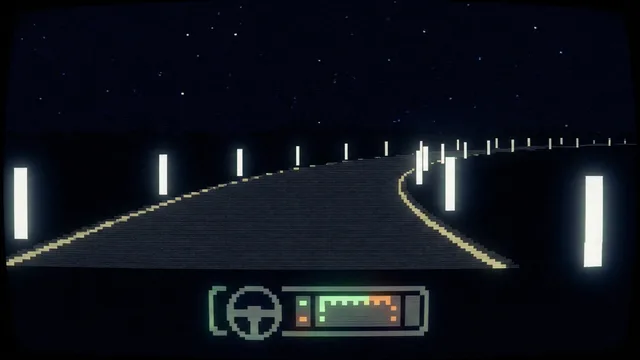
The 1976 first-person original: a pitch-black road defined only by roadside posts, played at night in every sense. Atmosphere as difficulty.
Oncoming-traffic runs
The mobile-era dare: drive against the flow on a two-way road, where every vehicle closes twice as fast and near-miss bonuses pay double the respect.
Checkpoint racers
The 1986-style arcade structure: a ticking timer that only checkpoint arrivals can extend, turning raw survival into a schedule you race against.
Racer Questions, Answered
What is the goal of Retro Racer?
How do near-miss bonuses work?
Is there a fuel gauge?
Can I brake or slow down?
Does the speed increase forever?
Is one crash really the end?
Does the daily Retro Racer run use the same traffic for everyone?
How does Retro Racer play on a phone?
More where Retro Racer came from: work through the skill & precision row, brush up in the arcade glossary, or settle score questions in the player FAQ. Guide last tuned 2026-07-19.