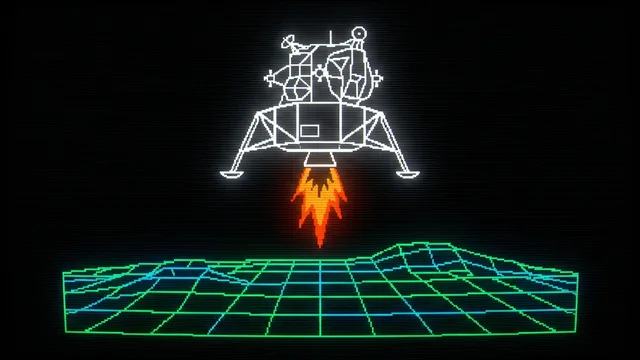
Inside the Lunar Lander Cabinet
TL;DR: Land the module gently on the flat pads before your fuel tank runs dry. Expect physics with consequences at a pace that's slow, tense, unforgiving.
Lunar Lander hands you a tiny spacecraft, a shrinking fuel tank, and one polite request: please do not hit the Moon very hard. Gravity pulls you down the whole time. Your only answers are rotating the module and firing the thruster, and every burn drinks fuel you will never get back.
The flat pads scattered across the jagged terrain are your targets, and the smallest, trickiest pads pay score multipliers to match the risk. Come in slow and level and you touch down like a feather; come in fast or tilted and you become a very expensive crater.
Our version keeps the classic rotate-and-thrust physics and turns the gravity up a notch with every safe landing, so no run stays comfortable for long. Play with keys or touch controls, chase the leaderboards, and try the daily seeded run, where everyone descends over the exact same terrain.
Cabinet Specs
| Mission | Land the module gently on the flat pads before your fuel tank runs dry. |
|---|---|
| Row | Arcade Classics |
| Skill curve | Physics with consequences |
| Tempo | Slow, tense, unforgiving |
| Lineage | 1979 (Atari vector cabinet) |
| Original | Lunar Lander - Atari, 1979 (full history) |
| Daily run | Seeded challenge, resets midnight UTC |
| Scoreboard | Global top 50, score-ranked |
Learn Lunar Lander in Five Moves
Read the terrain first
Look for the flat pads before you commit to a descent. Wider pads are forgiving; the narrow ones carry score multipliers because they demand a near-perfect approach.
Rotate to aim your burn
Use the left and right keys to tilt the module. The thruster always pushes opposite the way the module points, so tilting is how you steer sideways and how you cancel drift.
Fire the thruster in short bursts
Hold up (or hold a tap) to burn. Short, controlled bursts fight gravity without wasting fuel - A long panicked burn empties the tank and usually overshoots the pad anyway.
Kill your speed before the surface
A safe landing needs low downward speed, almost no sideways drift, and a nearly upright module. Arrive fast, sideways, or tilted, and the landing becomes a crash.
Land, collect, and climb
Every safe touchdown banks points, with multipliers for tough pads. Then the next descent begins with stronger gravity, so each landing is harder than the last.
Score Higher at Lunar Lander
Spend altitude, not fuel. Let gravity do the traveling while you are high up, and save your burns for the final approach - Fuel is the only resource in the game you can never win back.
- Zero your sideways drift early. Horizontal speed is the silent killer, so tilt against your drift and cancel it while you still have height to spare.
- Get upright before the last stretch. The final seconds should be pure vertical braking; if you are still rotating near the ground, you started fixing your approach too late.
- Pick your pad before you descend. Committing early lets you plan one smooth curve to the target instead of burning fuel on mid-air changes of heart.
- Chase multiplier pads only with a full tank. The narrow pads pay beautifully, but they demand extra correction burns you cannot afford on fumes.
- Use pulse braking near the ground. Tapping the thruster in a steady rhythm holds a gentle descent rate far more cheaply than one continuous burn.
- Respect the gravity creep. Each level pulls harder, so start your braking burns earlier every round - The habits from level one will crash you on level five.
House Rules & Spin-Offs
Text-mode Lunar Lander
The 1969 original: no graphics at all, just typed burn amounts and a printout of your speed and altitude. Pure arithmetic, real tension.
Atari vector cabinet
The 1979 arcade version with glowing line graphics, four difficulty missions, and a thrust lever you squeezed with both hands.
Thrust-style cave flyers
Descendants like Thrust and Gravitar turned the lander loose inside caverns, adding enemies and tractor beams to the same delicate physics.
Modern landing sims
From homebrew remakes to full spaceflight games, the soft-touchdown challenge lives on - Some even model the real Apollo descent profile.
Lander Questions, Answered
What counts as a safe landing?
What happens when I run out of fuel?
Why are some pads worth more points?
Does the game get harder as I play?
Is this how the real lunar module worked?
Where did Lunar Lander come from?
Does the daily run use the same terrain for everyone?
Can I play Lunar Lander on a phone?
When Lunar Lander finally lets you go, the arcade classics row has its siblings, the arcade glossary has the vocabulary, and the player FAQ has the house rules. Guide last tuned 2026-07-19.