Inside the Solitaire Cabinet
TL;DR: Build all four foundations from Ace to King by dragging cards across the tableau, one honest move at a time. Expect patience with sharp edges at a pace that's your pace, until the deck fights back.
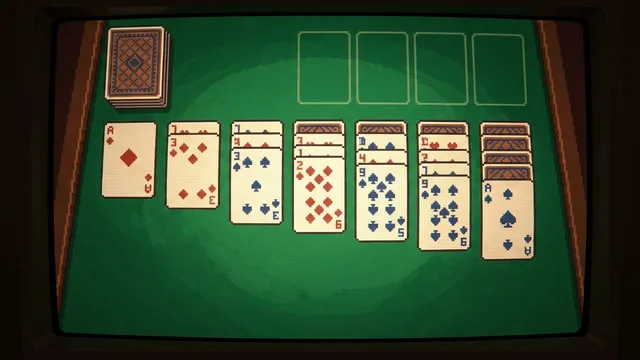
Solitaire is the most played card game in computing history, and this is the classic Klondike everyone means when they say the word. Twenty-eight cards fan out across seven tableau piles, the rest wait in the stock, and your mission is to walk all fifty-two home onto the four foundations, Ace to King, suit by suit.
On the tableau you build downward in alternating colors, prying face-down cards loose one reveal at a time; empty columns crave Kings; and the stock deals one card at a time with unlimited passes, so no deal dies while a line of play remains.
Our version keeps the ritual fully hands-on: drag any card or run and drop it where it belongs, with every legal destination glowing green under your fingers. Scoring rewards every reveal and every foundation card, with a time bonus for fast wins, and the daily seeded deal hands the entire world the same shuffle, which turns a solitary habit into a very public contest.
Cabinet Specs
| Mission | Build all four foundations from Ace to King by dragging cards across the tableau, one honest move at a time. |
|---|---|
| Row | Puzzle Arcade |
| Skill curve | Patience with sharp edges |
| Tempo | Your pace, until the deck fights back |
| Lineage | 1780s (patience) / 1990 (on every desktop) |
| Original | Solitaire - Microsoft, 1990 (full history) |
| Daily run | Seeded challenge, resets midnight UTC |
| Scoreboard | Global top 50, score-ranked |
Learn Solitaire in Five Moves
Read the layout
Seven tableau piles build downward in alternating red and black. The four foundations top-right collect each suit upward from Ace. The stock top-left deals into the waste pile beside it.
Drag cards where they belong
Pick up any face-up card (its whole run comes along) and drop it on a tableau pile or foundation. Legal targets glow green. Tap a face-down top card to flip it.
Draw from the stock
Tap the deck (or press Space) to turn one card into the waste. When the stock empties, tapping it recycles the waste for another pass.
Free the buried cards
Every face-down flip is progress and points. Favor moves that unbury columns over moves that merely look tidy.
Send everything home
The game is won when all four foundations run Ace to King. A win pays a big bonus plus extra for speed.
Score Higher at Solitaire
Always flip a face-down card when you can: information and options are worth more than any other single move on the board.
- Empty columns are for Kings, but not any King: prefer the King whose queen and jack you can already see somewhere on the table.
- Do not rush low cards to the foundations. A two or three parked up top may be exactly the landing spot a tableau shuffle needs later.
- Unbury the tallest face-down stacks first; the left piles hide fewer secrets than the right ones on a fresh deal.
- Before drawing from the stock, exhaust the tableau: every draw buries the waste card beneath it one deeper for the rest of the pass.
- Aces and deuces go up immediately, always; the exceptions solitaire theorists argue about almost never apply at arcade pace.
- Track what the recycle will bring back. If a full stock pass produced no moves, the deal is dead, so spend risky moves before the pass ends.
House Rules & Spin-Offs
Klondike
The world's default solitaire and the game on this page: seven piles, alternating colors, foundations Ace to King.
Spider
Ten piles and eight foundations built in-suit; a heavier meal for players who find Klondike too merciful.
FreeCell
Every card dealt face-up plus four free cells: near-total information, near-total responsibility.
Pyramid and TriPeaks
Pairing and sequencing variants that trade the tableau for card-shaped geometry; faster, lighter, streak-friendly.
Solitaire Questions, Answered
Is this draw-one or draw-three?
How do I move a whole stack?
Can every deal be won?
How is the score calculated?
Is the daily deal really identical for everyone?
Still warming up? Browse the whole puzzle arcade row for more like Solitaire, decode the lingo in the arcade glossary, or check the player FAQ for how scores, dailies and accounts work. Guide last tuned 2026-07-19.