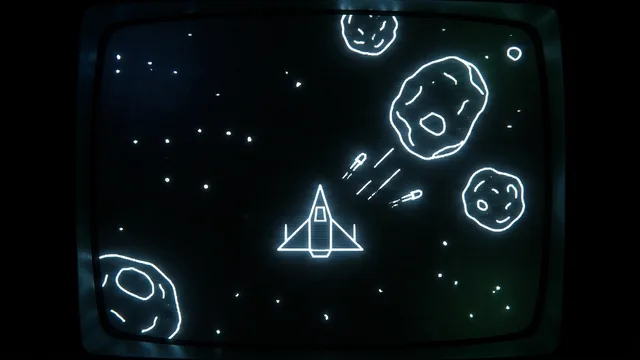
Inside the Asteroids Cabinet
TL;DR: Split giant asteroids into smaller pieces and clear the field without crashing. Expect physics take a session to click at a pace that's momentum-driven - you set the tempo.
Asteroids hands you a tiny triangle, a screen full of tumbling rocks, and the most honest physics in arcade history. Your ship keeps drifting the way you last pushed it - Thrust is a promise you have to keep.
Shoot a big asteroid and it splits into two medium rocks; shoot those and they burst into fast little ones, so every trigger pull makes the room busier before it makes it safer.
Saucers wander in looking for a fight, the screen edges wrap around like the whole galaxy is a donut, and the hyperspace button will either save you or scramble you straight into a boulder - It never says which.
Our version keeps that glowing vector look and drift-and-fire feel, adds touch thrusters for mobile, and runs a daily seeded rock field so every pilot dodges the same debris. Leaderboards keep the scores honest. Momentum keeps you humble.
Cabinet Specs
| Mission | Split giant asteroids into smaller pieces and clear the field without crashing. |
|---|---|
| Row | Space Shooters |
| Skill curve | Physics take a session to click |
| Tempo | Momentum-driven - You set the tempo |
| Lineage | 1979 (Atari) |
| Original | Asteroids - Atari, 1979 (full history) |
| Daily run | Seeded challenge, resets midnight UTC |
| Scoreboard | Global top 50, score-ranked |
Learn Asteroids in Five Moves
Rotate first, thrust second
Left and right arrows spin the ship in place; up fires the engine in whatever direction the nose points. There are no brakes - To slow down, turn around and thrust the opposite way.
Split rocks down to gravel
Big asteroids break into two medium rocks, mediums into two smalls, and smalls vanish for the best points. The wave only ends when every last fragment is dust.
Use the wrap-around edges
Fly off any side of the screen and you reappear on the opposite side. Rocks and bullets wrap too - Yours and the saucers' - So nothing ever really leaves the arena.
Duel the saucers
The big saucer fires randomly and mostly embarrasses itself; the small one aims at you and shows up more as your score climbs. Both pay well if you shoot first.
Gamble on hyperspace
When you are cornered, hyperspace teleports you to a random spot on the screen - Which can be open space or the inside of a rock. It is an emergency exit, not a travel plan.
Score Higher at Asteroids
Tap thrust, never hold it. Short bursts keep your drift slow enough to react to what wraps in; a ship at full speed crosses the screen faster than you can think, and momentum does not care that you changed your mind.
- Break one big rock at a time. Blasting every large asteroid at once floods the screen with fast small ones - Controlled demolition clears waves, fireworks end runs.
- Shoot through the wrap. A bullet fired off the left edge arrives from the right, so you can snipe rocks and saucers behind you without ever turning around.
- Kill the small saucer on sight. Its aim sharpens as your score climbs until it is nearly a marksman - It pays the biggest bounty in the game precisely because letting it line up a shot is fatal.
- Hunt from the middle of the screen. Everything wraps in from the edges, so the center gives you the longest warning on every new rock and every new saucer.
- Save hyperspace for true dead ends. It drops you somewhere random and sometimes that somewhere is inside an asteroid - Press it only when every flyable exit is already closed.
- Farm saucers off the last small rock. As long as one fragment drifts, the next wave holds off while saucers keep arriving - The classic arcade 'lurking' trick for stacking bonus points before you finish the field.
House Rules & Spin-Offs
Asteroids Deluxe (1981)
Atari's anti-lurking sequel swapped hyperspace for a draining shield and added a killer satellite that splits into ships that home in on campers.
Space Duel (1982)
Replaced rocks with colorful geometric shapes and let two players fly at once - Including a mode where both ships are tethered together.
Blasteroids (1987)
A raster-graphics remake with ships that transform between speed, firepower, and armor forms, plus a giant boss saucer named Mukor.
Atari 2600 Asteroids (1981)
The home port packed in 66 selectable rule sets, mixing and matching shields, flip controls, and slower rocks for living-room play.
Asteroids Questions, Answered
Why does my ship keep drifting after I stop thrusting?
What happens when I shoot a big asteroid?
Is hyperspace safe to use?
What is the difference between the two saucers?
Do bullets wrap around the screen like the ship does?
Why does Asteroids look like glowing lines?
Is the daily Asteroids run the same field for everyone?
How do I play Asteroids on a touchscreen?
Not done yet? The rest of the space shooters row is one click from Asteroids, the arcade glossary translates the slang, and the player FAQ covers scores, dailies and accounts. Guide last tuned 2026-07-19.