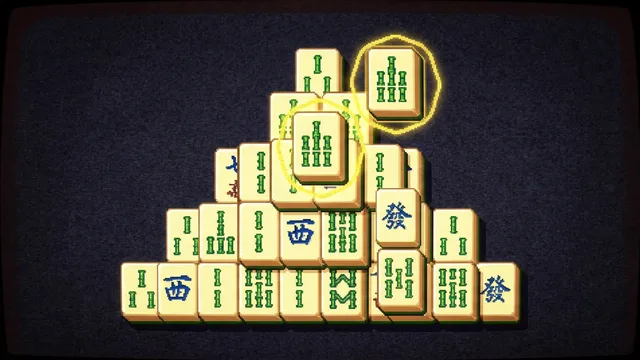
Quick take: Mahjong is our tribute to Mahjong Solitaire, the single-player tile game Brodie Lockard built in 1981 on the PLATO education system as 'Mah-Jongg.' Long before it became a quiet fixture of home computers, it took the beautiful 144-tile set of the four-player table game and reimagined it as a solo puzzle: a stacked mountain of tiles you clear by matching free pairs.
Mahjong is our tribute to Mahjong Solitaire, the single-player tile game Brodie Lockard built in 1981 on the PLATO education system as 'Mah-Jongg.' Long before it became a quiet fixture of home computers, it took the beautiful 144-tile set of the four-player table game and reimagined it as a solo puzzle: a stacked mountain of tiles you clear by matching free pairs.
Only tiles with an open left or right edge and nothing on top can be lifted, so every pair you remove reshapes what is reachable next. Activision's Shanghai turned the idea into a mainstream hit in 1986, and the layout became one of the most recognizable in all of casual gaming.
It is a game of foresight rather than luck, where the losing move is often made twenty tiles earlier - and it has nothing to do with the gambling table game beyond the tiles they share.
Mahjong Solitaire Fast Facts
| Original title | Mahjong Solitaire (Mah-Jongg) |
|---|---|
| Debuted | 1981, on the PLATO system |
| Created by | Brodie Lockard |
| Genre | Tile-matching solitaire |
| Built on | The 144-tile mahjong set |
| Popularized by | Activision's Shanghai (1986) |
| Our tribute | Mahjong |
Why Mahjong Solitaire Mattered
- Created by Brodie Lockard in 1981 on the PLATO mainframe as a solo take on the classic mahjong tile set, years before it reached home computers.
- Uses the full 144-tile mahjong set - suits, honors, flowers and seasons - but plays as a solitaire puzzle rather than the four-player table game.
- The rule is simple and merciless: you may only remove a matching pair of tiles that are 'free', meaning open on the left or right with nothing stacked on top.
- Activision's Shanghai (1986) brought the layout to the Amiga, Mac and beyond, making the turtle-shaped stack an icon of casual computing.
- Rewards planning over speed - a solvable board can still be lost by clearing the wrong pair and burying the tiles you needed.
- Shipped with countless PC tile sets and clones, becoming one of the most widely played puzzle formats ever made.
Mahjong Solitaire Timeline
| Year | Milestone |
|---|---|
| 1981 | Brodie Lockard builds a single-player mahjong tile game on the PLATO system. |
| 1986 | Activision releases Shanghai, popularizing the solitaire layout on home computers. |
| 1990s | Tile-matching sets ship on countless PCs, cementing the turtle stack as a casual staple. |
| 2000s | Free browser versions carry Mahjong Solitaire to a mass online audience. |
| Today | Layouts from the turtle to the dragon keep the match-free-pairs puzzle alive worldwide. |
Why Mahjong Solitaire Still Matters
Mahjong keeps the part that made the original endure - a gorgeous tile set, a stack that hides its own solution, and a puzzle you win with patience rather than reflexes. We match the classic free-pair rule and the layered mountain, then add multiple layouts, a daily seeded deal every player shares and leaderboards for the fastest clears. The tiles are the same ones Brodie Lockard borrowed in 1981; the challenge is still reading three moves ahead. Clear the mountain before it buries the pair you need.