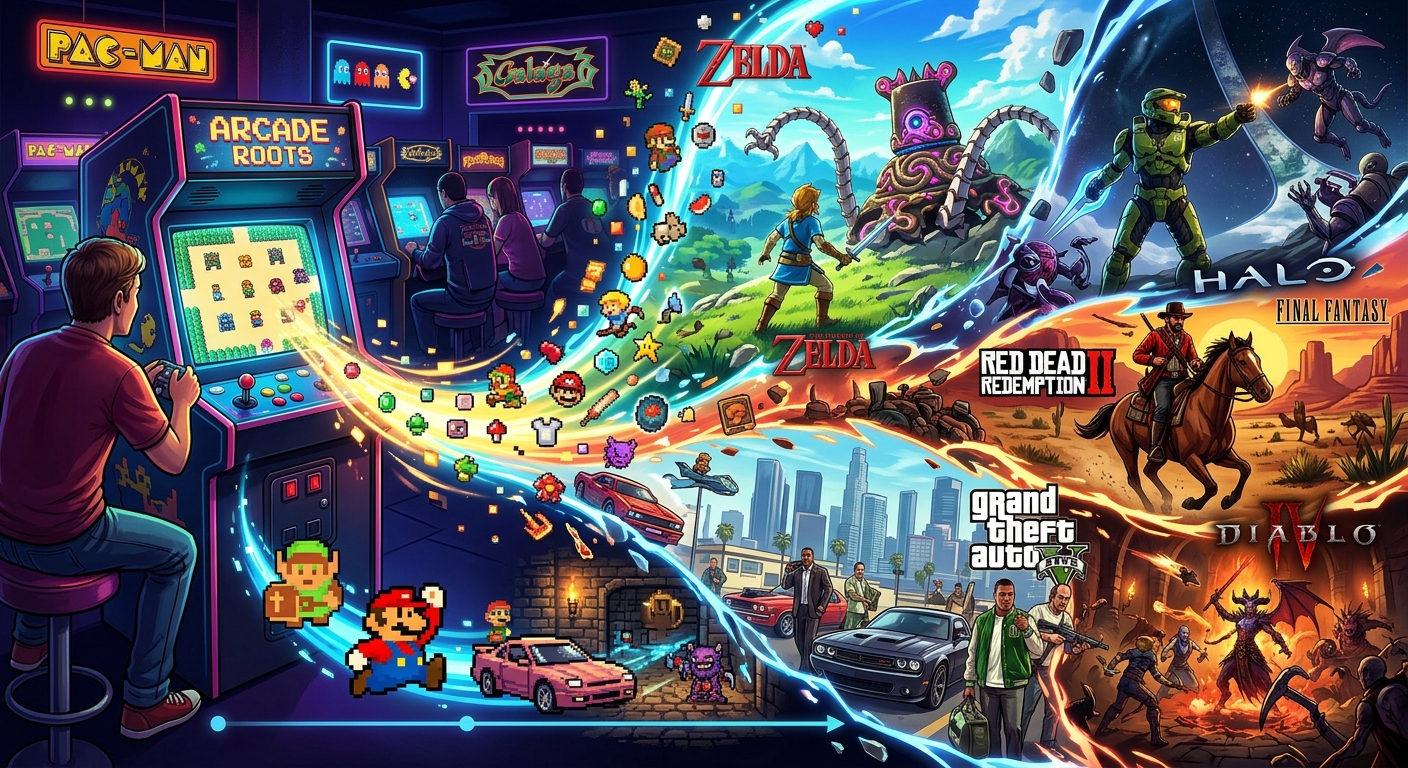
The cabinet was about the size of a refrigerator. The screen was smaller than a modern laptop. The controls were a joystick and maybe two buttons. And yet, those dimly lit boxes standing in rows at early 1980s arcades contained ideas so durable that their descendants are still pulling in billions of dollars today. Not just inspiration. Actual mechanical DNA, passed down through decades of iteration, genre shifts, and hardware leaps. The top-down view was not a stylistic quirk. It was the starting point for entire lineages of games.
Arcade DNA
- Early top-down arcade games were shaped by hardware constraints, not artistic vision, yet those constraints produced timeless design.
- The bird's-eye perspective stripped mechanics to their essentials, building feedback loops so effective that modern franchises still replicate them.
- Grand Theft Auto launched as a top-down arcade-style game, and understanding that origin explains everything about how the series became what it is.
The Quarter-Munching Blueprint That Built Modern Gaming
Early arcade developers were not thinking about franchises. They were thinking about time. Specifically, how to make a player spend as much of it as possible at the machine before the game ended. The top-down view was a practical choice. It let designers see the entire play space at once. No camera management. No perspective tricks. Just a clean grid of information that both the player and the hardware could process fast.
This simplicity forced a kind of design discipline that is hard to replicate on purpose. Every element had to earn its place. Every mechanic had to be readable in a fraction of a second. The ideas that survived that filter were extraordinarily robust. They did not just work for one game or one genre. They became the skeleton that later franchises would build entire worlds around.
The real miracle is that nobody planned it this way. The top-down view was a workaround. It became a blueprint.
Why Looking Down Made Total Sense in 1980
The processing power inside a 1980 arcade cabinet was minuscule by any modern measure. Rendering a three-dimensional world was not just difficult, it was impossible with that technology. Designers had a choice: go side-scrolling or go top-down. Both became hugely popular, but the top-down view offered something side-scrolling struggled with. It gave the designer control over space in two dimensions simultaneously.
Games like Space Invaders, Asteroids, and Gauntlet used this to create environments that felt genuinely threatening from every direction. Enemies could come from above, below, left, or right. That 360-degree threat space created a kind of tension that players felt physically. Shoulders tightened. Reflexes sharpened. Hearts went a little faster. That feeling was addictive, and it was not an accident.
That arcade's golden age ran from roughly 1978 to 1983, and during that window, top-down games dominated the highest-earning cabinets. The design principles those games established did not disappear when the era ended. They went underground and re-emerged wearing different clothes.
Pac-Man and the Feedback Loop That Still Works
Pac-Man is one of the most studied games in design history. What makes it exceptional is not the pellets or the ghosts in isolation. It is the loop. Player moves, ghosts respond, tension builds, player finds a power pellet, roles reverse, brief euphoria, tension builds again. That loop takes about forty-five seconds to complete naturally, and it is almost impossible to stop voluntarily.
Pac-Man's top-down maze view was essential to that loop. The player needed to see the whole board. They needed to make spatial decisions fast. Hiding parts of the map behind a camera would have broken the tension entirely because the threat would have been invisible. The bird's-eye view was not just a limitation being worked around. It was an active design ingredient.
Namco understood this so well that Pac-Man spawned sequels, spin-offs, animated shows, merchandise, and eventually mobile games that are still downloaded today. The franchise did not survive because of nostalgia alone. It survived because the core loop is genuinely great, and that loop was born from top-down thinking.
When Crime Went Bird's-Eye First
Few franchises in gaming history made a more dramatic genre leap than Rockstar's flagship series. The first Grand Theft Auto, released in 1997, looked nothing like the open-world behemoth players know today. It was a top-down arcade crime game. Players drove stolen cars through a gridded city viewed from above. The camera sat directly overhead. Traffic, pedestrians, and police all moved across a flat plane.
That original format had genuine arcade energy. The chaos was immediate and readable. Players could see threats coming from any direction. The wanted system, the mission structure, the anarchic sandbox feel: all of it made sense within the top-down frame. Understanding Grand Theft Auto origins makes the 3D leap of GTA III feel less like a genre reinvention and more like a logical upgrade. The bones were already there. The team just added a third dimension around them.
The core design ideas that made the original compelling, the open city, the escalating chaos, the player-driven mayhem, carried across perfectly. Top-down arcade design did not limit what GTA became. It created the foundation that made the 3D version possible.
The Franchises That Carried the Top-Down Torch
Grand Theft Auto is the most dramatic example, but not the only one. Several franchises that dominate modern gaming trace a clear line back to top-down arcade roots. The pattern repeats across genres and decades.
- The Legend of Zelda began in 1986 as a top-down adventure game with a fixed overhead camera. That perspective shaped every design decision in the original, from dungeon layouts to hidden secrets. The series moved to 3D with Ocarina of Time, but top-down Zelda never went away. Games like Link's Awakening and A Link Between Worlds still use the format today.
- Hotline Miami proved in 2012 that the top-down perspective still had enormous commercial and critical potential. It became a cult hit and directly influenced a wave of indie games, showing that modern audiences had not outgrown the format at all.
- Gauntlet ran as an arcade dungeon crawler from 1985 and is considered one of the earliest true action RPGs. It established enemy-swarming, resource management under pressure, and co-op play. Those concepts power modern games from Diablo to Path of Exile.
- Twin-stick shooters as a genre trace their ancestry directly to Robotron 2084 and Smash TV, both top-down arcade games. The genre had a major revival with Geometry Wars and Nex Machina, and it still sells consistently today.
The 3D Pivot and What Never Changed
The shift from 2D to 3D gaming in the mid-1990s looked like it would make top-down design obsolete. It did not. What actually happened was a split in the road. Some franchises went fully 3D and kept the camera flexible. Others kept the top-down view and just added more visual depth. A third category, the most interesting one, went 3D but retained every design principle the top-down era had established.
That third category is where the real legacy lives. Game systems built in arcades, threat visibility, spatial clarity, pacing through feedback loops, and session design built for tension, these ideas survived the hardware shift completely. Modern battle royale games owe a structural debt to the visible threat space of early top-down titles. Modern action RPGs owe Gauntlet more than most of their developers probably realize.
The lessons encoded in those original cabinets were not about graphics. They were about feel. And feel does not care what resolution the screen runs at.
The Overhead View Lives in Everything You Play
Top-down arcade games are easy to underestimate because they look simple. That simplicity is the whole point. Reducing a game to its essential interactions, what the player does, what the world does in response, and how the tension escalates, requires a level of design rigor that is genuinely rare.
The franchises that grew from this tradition became dominant not by abandoning what made the originals work, but by preserving it. The camera angle changed. The budgets expanded by factors of thousands. The stories got more complex. But the heartbeat underneath stayed exactly where it always was: readable, responsive, relentless. Right there in the original arcade cabinet, demanding one more quarter.
Top-down arcade design did not fade into irrelevance. It became the invisible infrastructure of modern gaming. The next time you play an open-world game and feel that pull to keep pushing forward, or a dungeon crawler where the threat from every angle keeps you alert: that is the arcade calling. It never stopped.